Every business with an online presence wants the same thing: a website that turns visitors into customers. Yet most websites fall short, not because they look unprofessional, but because they lack the structural and strategic elements that drive action. Ahigh-converting website is not simply one that looks good. It is one that is built around the way real people browse, evaluate, and make decisions. Understanding what separates a high-performing site from a passive online brochure is the first step toward building something that genuinely grows your business.
The good news is that the principles behind conversion are not mysterious. Decades of web design research, real-world testing, and consumer behaviour studies have consistently identified the same core factors. Whether you are launching your first website or reassessing an existing one, these seven elements form the foundation of any site that reliably converts visitors into leads, calls, and paying customers. Each one is actionable, measurable, and within reach for any business, regardless of budget or technical background.
At Park Media, we build every website subscription with these principles baked in from day one. This post walks through each element in plain terms so you can evaluate your own site, or know exactly what to look for when working with a professional web team.
[IMAGE-1]1. A Clear Value Proposition Above the Fold
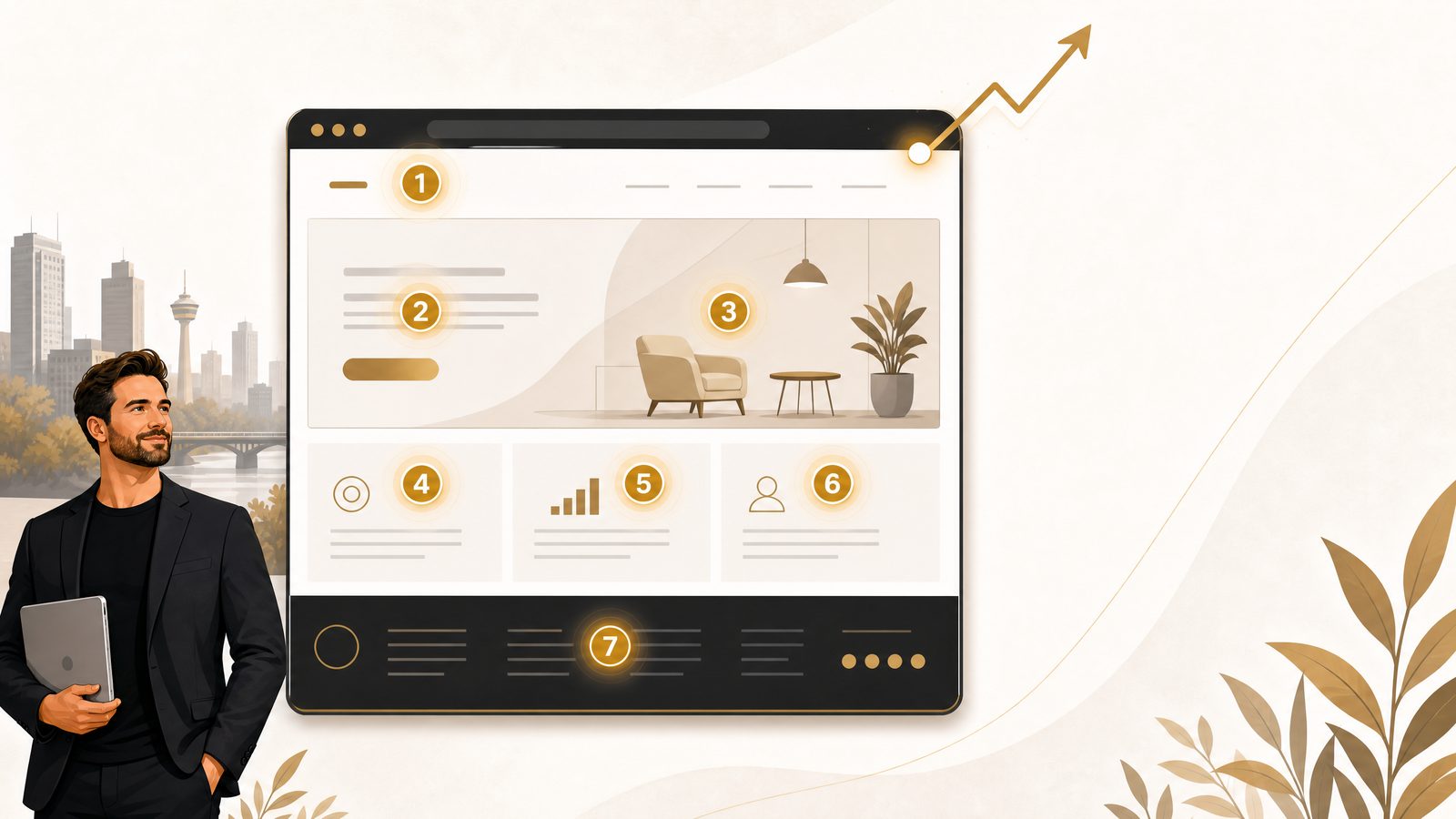
The “above the fold” area, everything a visitor sees before they scroll, is the most valuable real estate on your website. You have a matter of seconds to communicate who you are, what you offer, and why a visitor should stay. A strong value proposition answers three questions immediately: What do you do? Who do you serve? Why should someone choose you over anyone else?
Avoid vague taglines like “Your Trusted Partner in Excellence.” Instead, be specific and direct. “Custom Landscaping Services in Regina: Free Estimates, Fully Insured” tells a visitor exactly what they need to know without requiring them to dig. Pair this with a clear headline, a supporting sentence or two, and a prominent call-to-action button, and your above-the-fold section becomes a powerful first handshake.
2. Fast, Mobile-First Design
The majority of web traffic now comes from mobile devices. If your website is slow to load or difficult to navigate on a smartphone, you are losing visitors before they have a chance to engage. Page speed is not just a user experience issue: it is a ranking factor in Google search results. A site that takes more than three seconds to load will see a significant portion of its visitors leave before the page even appears.
Mobile-first design means building your site with the phone experience as the primary consideration, then scaling up to desktop, not the reverse. This approach ensures buttons are easy to tap, text is readable without pinching, and forms are simple to complete on a small screen. Ahigh-converting website performs consistently well across every device a potential customer might use to find you.
What to Check on Your Own Site
- Does your homepage load in under three seconds on a mobile connection?
- Are your buttons and links easy to tap without zooming?
- Does your navigation collapse cleanly into a mobile menu?
- Is your text legible without horizontal scrolling?
3. Trust Signals That Reassure Visitors
Online visitors are naturally cautious. Before they call you or submit a form, they want evidence that you are legitimate, experienced, and trustworthy. Trust signals are the elements on your site that provide that reassurance. They include customer reviews and testimonials, industry certifications or memberships, years in business, recognizable client logos, and professional photography.
Google and Facebook reviews are particularly powerful because they come from third-party platforms that visitors trust. Embedding a handful of genuine reviews directly on your homepage or service pages reinforces credibility without feeling self-promotional. Trust signals work quietly in the background, lowering the psychological barrier between a visitor browsing your site and a visitor picking up the phone.
4. Obvious, Well-Placed Calls-to-Action
A call-to-action (CTA) is any prompt that tells a visitor what to do next: “Request a Quote,” “Book a Free Consultation,” “Call Us Now.” Without clear CTAs, visitors are left to figure out the next step on their own, and most will not bother. Every page on your site should have at least one prominent CTA that aligns with the intent of that page.
Effective CTAs are specific, action-oriented, and visually distinct. A button that reads “Get Your Free Estimate” will consistently outperform one that says “Learn More” because it tells the visitor exactly what they will receive. Place CTAs above the fold, after key sections of content, and at the bottom of every page. Repetition is not pushy: it is helpful navigation.
5. Simple, Intuitive Navigation
Navigation is the map your visitors use to explore your site. When it is cluttered, confusing, or buried, visitors give up and leave. A high-converting websitekeeps its navigation lean, typically five to seven items in the main menu, and organizes pages in a way that mirrors how customers think about your business, not how you think about it internally.
Every important page should be reachable within two clicks from the homepage. If you offer multiple services, group them logically under a single “Services” menu item with a dropdown rather than cluttering the top navigation bar. A clean navigation structure also helps search engines crawl and index your site more effectively, which supports your broader SEO strategy.
[IMAGE-2]6. Dedicated Service and Location Pages
One of the most impactful structural decisions you can make for a high-converting websiteis creating individual pages for each of your core services and the geographic areas you serve. A single page that vaguely describes everything you do is far less effective, both for visitors and for search engines, than a focused page dedicated to a specific service in a specific location.
For example, if you are an HVAC company serving Saskatoon and Regina, a dedicated “Furnace Installation Saskatoon” page will rank far better in local search results than a generic services overview page. This approach also allows you to tailor the content, testimonials, and CTAs to the specific audience visiting that page. Our Saskatoon web design projects consistently prioritize this structure, as do our Calgary and Edmonton builds.
Why Location Pages Matter for Local Businesses
When someone searches “plumber near me” or “accountant in Lloydminster,” Google serves results based on geographic relevance. Without pages that explicitly reference your service areas, your site is invisible in those searches. Dedicated location pages are one of the most straightforward ways to expand your local search footprint and capture high-intent traffic from customers who are ready to buy.
7. Easy Contact Options: Forms, Click-to-Call, and More
The final element of a high-converting website is friction-free contact. If a visitor has to hunt for your phone number, navigate through multiple pages to find a contact form, or fill out a lengthy questionnaire just to ask a question, many of them will abandon the effort entirely. Make it as easy as possible to get in touch, in whatever way your customers prefer.
Your phone number should appear in the header on every page, formatted as a click-to-call link on mobile. Contact forms should be short: name, phone or email, and a brief message field are typically sufficient for a first inquiry. Consider also adding a live chat option or a booking widget if your service lends itself to appointment scheduling. The fewer steps between “I’m interested” and “I’ve made contact,” the higher your conversion rate will be.
Summary: 7 Elements and Their Conversion Impact
The table below summarizes each of the seven elements of a high-converting website alongside their primary impact on visitor behaviour and business outcomes.
| Element | Primary Conversion Impact | Priority Level |
|---|---|---|
| Clear Value Proposition Above the Fold | Reduces bounce rate; immediately communicates relevance | Critical |
| Fast, Mobile-First Design | Retains mobile visitors; supports Google rankings | Critical |
| Trust Signals (Reviews, Credentials) | Lowers psychological barrier to making contact | High |
| Obvious Calls-to-Action | Guides visitor to the next step; increases lead volume | Critical |
| Simple, Intuitive Navigation | Reduces frustration; improves page depth and time on site | High |
| Dedicated Service and Location Pages | Captures local search traffic; improves relevance per visitor | High |
| Easy Contact Options | Removes friction from the final conversion step | Critical |
Putting It All Together
A high-converting website is not the result of one brilliant design decision: it is the cumulative effect of getting each of these foundational elements right. When your value proposition is sharp, your site loads quickly, your trust signals are visible, your CTAs are clear, your navigation is simple, your pages are focused, and your contact options are frictionless, you have built a website that is genuinely working for your business around the clock.
The Park Media website subscriptionis designed to deliver all seven of these elements in a done-for-you format, with ongoing hosting, maintenance, security, and support included. Plans start at $119 per month, and you can review all options at oursubscription pricing page. There are no long-term contracts, just flexible month-to-month terms that put you in control.
A website that looks professional but fails to convert is not an asset: it is a missed opportunity. Every element on this list exists to close the gap between a visitor arriving and a customer calling.
Ready to Build a Website That Converts?
Park Media is a Canadian Owned and Operated digital agency serving businesses across Saskatchewan, Alberta, and beyond. If you are ready to launch a professionally built, high-converting website on flexible month-to-month terms, with a team that handles everything from design to ongoing support, getting started takes less than five minutes.