
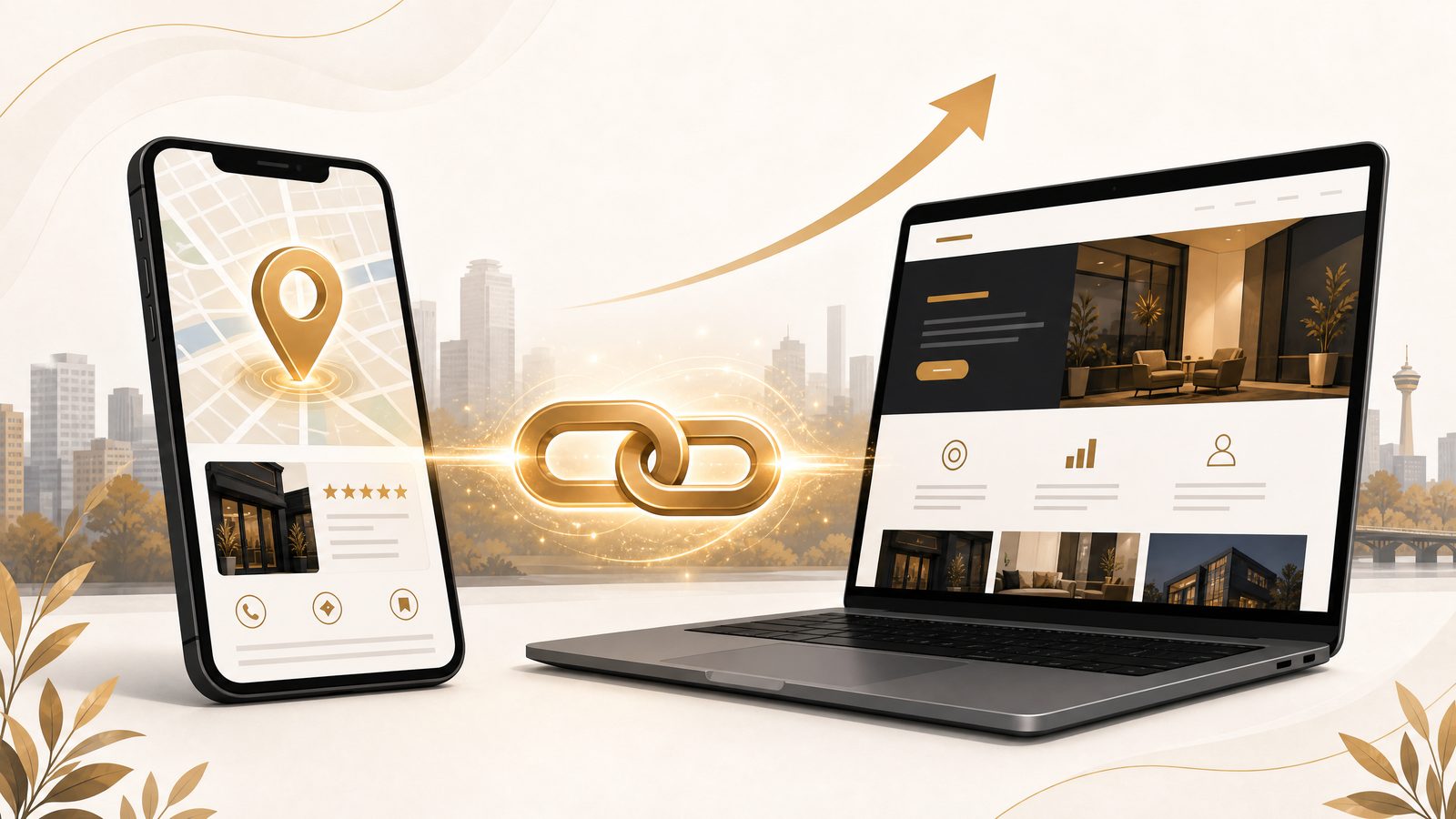
If you have ever searched for a service in your city and seen that cluster of three businesses appear under a map near the top of the results, you have witnessed the Google Business Profile website combination at work. That map pack placement is prime real estate, and earning it while also ranking in the organic results below it is the local visibility formula that consistently outperforms either tactic on its own. For Saskatchewan and Alberta businesses looking to attract more customers from search, understanding how these two assets reinforce each other is one of the highest-value things you can invest time in this year.
The challenge is that many businesses treat these as separate to-do items: they claim a Google Business Profile, fill in the basics, and call it done, or they build a website without ever properly connecting it to their profile. That gap quietly costs clicks, calls, and conversions every single day. This guide walks through exactly how a Google Business Profile and a professional website work together, what a proper setup looks like, and how to maintain both so the results compound over time.
Whether you are just establishing your online presence or you are looking to get more out of what you already have, the steps here are practical, actionable, and built for business owners, not web developers.
[IMAGE-1]Why Google Business Profile and Your Website Are Stronger Together
Google Business Profile (formerly Google My Business) governs your visibility in what is called the local pack, the map-based results that appear for searches like “electrician Saskatoon” or “accountant Calgary.” Your website, on the other hand, governs your organic search presence: the traditional blue-link results that appear below the map. These two placements serve different stages of the same customer journey, and that is exactly why combining them is so powerful.
A well-optimized Google Business Profile wins the map pack and drives calls, direction requests, and profile visits. A professional website wins organic rankings and converts that traffic into leads, inquiries, and sales. When a potential customer sees your business in the map pack and clicks through to a polished, informative website, the trust built in those first few seconds dramatically increases the likelihood they contact you. If the website link leads somewhere slow, outdated, or missing, that trust evaporates immediately.
There is also a direct ranking benefit. Google uses signals from your website, including the consistency of your business name, address, and phone number (NAP), relevant content, and inbound links, to validate and boost your Business Profile. The relationship runs both directions: your profile sends referral traffic to your site, and your site sends authority signals back to your profile.
How to Connect Your Google Business Profile and Website Properly
Getting the technical connection right is the foundation everything else is built on. Many businesses skip or rush these steps, which is one of the most common setup gaps we see.
Step 1: Verify Your NAP Consistency
Your business name, address, and phone number must appear on your website exactly as they appear in your Google Business Profile, same spelling, same abbreviations, same format. Even small discrepancies (for example, “Ave.” versus “Avenue”) create conflicting signals that can suppress your local rankings. Place this information in your website footer and on your Contact page at minimum.
Step 2: Add Your Website URL to Your Profile
Inside your Google Business Profile dashboard, confirm that the website URL field points to the correct page, typically your homepage or a dedicated local landing page. If you run multiple locations, each profile should link to a location-specific page on your website, not the same generic homepage.
Step 3: Use UTM Parameters to Track Profile Traffic
Add a UTM tracking parameter to the URL you use in your Google Business Profile so you can see exactly how much traffic it sends to your website inside Google Analytics. A simple parameter like ?utm_source=google&utm_medium=organic&utm_campaign=gbp appended to your URL takes two minutes to set up and gives you ongoing visibility into what is working. Without this, profile-driven visits are often lumped in with other organic traffic and you lose the ability to measure the channel accurately.
Step 4: Embed a Google Map on Your Contact Page
Embedding your Google Business Profile map on your website Contact page reinforces the geographic relevance of your business for local searches and makes it easier for customers to find you. It is a minor addition that contributes a meaningful local signal.
Step 5: Align Your Website Content with Your Profile Categories
The primary and secondary categories you select in your Google Business Profile tell Google what your business does. Your website should have dedicated, well-written pages or sections that align with those categories. If your primary category is “Landscaping Service,” your website should have a clear, substantive landscaping services page, not a single line of text buried in a general page. This content alignment is one of the strongest ranking signals you can control.
Posts, Photos, and Reviews: The Ongoing Strategy
Claiming and connecting your profile is the starting point. The businesses that consistently appear at the top of the local pack are the ones that treat their Google Business Profile as a living asset, not a set-and-forget listing.
Google Posts
Google Posts allow you to publish short updates, offers, and announcements directly to your Business Profile, and they appear in your profile on both Search and Maps. Posting regularly (aim for at least twice per month) signals to Google that your business is active and relevant. Link posts back to relevant pages on your website to drive traffic and reinforce the connection between the two platforms.
Photos
Profiles with a strong photo library consistently receive more engagement than those without. Upload photos of your work, your team, your location, and your products or services. Use descriptive file names before uploading where possible, and add captions. Fresh photos uploaded regularly also signal activity to Google’s ranking algorithm.
Reviews
Reviews are among the most influential local ranking factors and conversion factors simultaneously. A business with 40 reviews averaging 4.7 stars will outperform a competitor with 5 reviews almost every time, regardless of how good the website is. Build a simple process for asking satisfied customers for a review: a follow-up email with a direct review link, a card at the point of sale, or a prompt on your website’s thank-you page. Always respond to reviews professionally, both positive and negative, as those responses are visible to every future customer who reads them.
[IMAGE-2]Common Setup Gaps Businesses Miss
After working with businesses across Saskatchewan and Alberta, certain missed steps come up repeatedly. Here are the most common gaps that quietly limit local visibility:
- Unclaimed or unverified profiles:A Business Profile that has not been claimed and verified through Google gives you no ability to manage what appears, and competitors or random users can suggest incorrect edits.
- Mismatched business hours: Hours on the website and hours in the Google Business Profile that do not match create confusion for customers and inconsistency for Google.
- No service area defined: Service-area businesses that travel to customers rather than receiving them at a fixed address often forget to set their service area in the profile, which limits the geographic range of their map pack visibility.
- Missing or thin website content: A Google Business Profile linked to a one-page website with minimal content leaves ranking potential on the table. Each service you offer deserves its own dedicated section or page.
- No Google Search Console or Analytics connected: Without these tools connected to your website, you are flying blind on what traffic your profile and organic rankings are generating.
- Ignoring the Q&A section: The Questions and Answers section on your Business Profile is publicly visible and can be populated by anyone. Monitor it regularly and seed it with useful questions and answers that reflect what your customers actually ask.
Monthly Maintenance: GBP and Website Tasks at a Glance
Consistency is what separates businesses that maintain strong local visibility from those that see it fade. The following table outlines the key tasks to maintain across both your Google Business Profile and your website, organized by frequency.
| Task | Platform | Frequency |
|---|---|---|
| Publish a Google Post (update, offer, or news) | Google Business Profile | 2x per month |
| Upload new photos | Google Business Profile | Monthly |
| Respond to new reviews | Google Business Profile | Weekly |
| Check and update business hours (holidays, seasonal) | Both | As needed / monthly check |
| Review Q&A section for new questions | Google Business Profile | Monthly |
| Check NAP consistency across profile and website | Both | Quarterly |
| Review UTM traffic data in Google Analytics | Website / Analytics | Monthly |
| Update or expand service/location page content | Website | Quarterly |
| Check website speed and mobile usability | Website | Quarterly |
| Add new project photos or case studies to website | Website | Quarterly |
| Request reviews from recent customers | Google Business Profile | Ongoing |
How a Professional Website Subscription Makes This Sustainable
One of the reasons businesses fall behind on the website side of this equation is that maintaining a site, keeping it updated, secure, fast, and relevant, takes time and expertise that most business owners do not have to spare. That is the problem Park Media’swebsite subscription service was built to solve.
For a predictable monthly investment starting at $119 per month, you get a professionally designed, hosted, maintained, and supported website on flexible month-to-month terms, with no long-term contracts, no surprise bills, no technical headaches. TheWebsite Growth plan at $199 per month includes expanded features suited for businesses actively building their local presence.
For businesses in Saskatoon and across Saskatchewan, our team understands the local market and builds websites designed to perform in it. If you are in Alberta, our Calgary web design and Edmonton web design services bring the same approach to your market. And if you want to amplify your visibility further, our SEO servicesare built to work in direct alignment with your Google Business Profile strategy, not in isolation from it.
Park Media is Canadian Owned and Operated, and every website we build is designed with Canadian businesses and Canadian customers in mind.
Ready to Build Your Local Visibility the Right Way?
A strong Google Business Profile and a professional website are not optional extras for businesses that want to compete locally. They are the foundation. When connected properly and maintained consistently, they create a compounding visibility advantage that is genuinely difficult for competitors to overcome. If you are ready to put that foundation in place with a team that handles the technical side for you, getting started is straightforward.