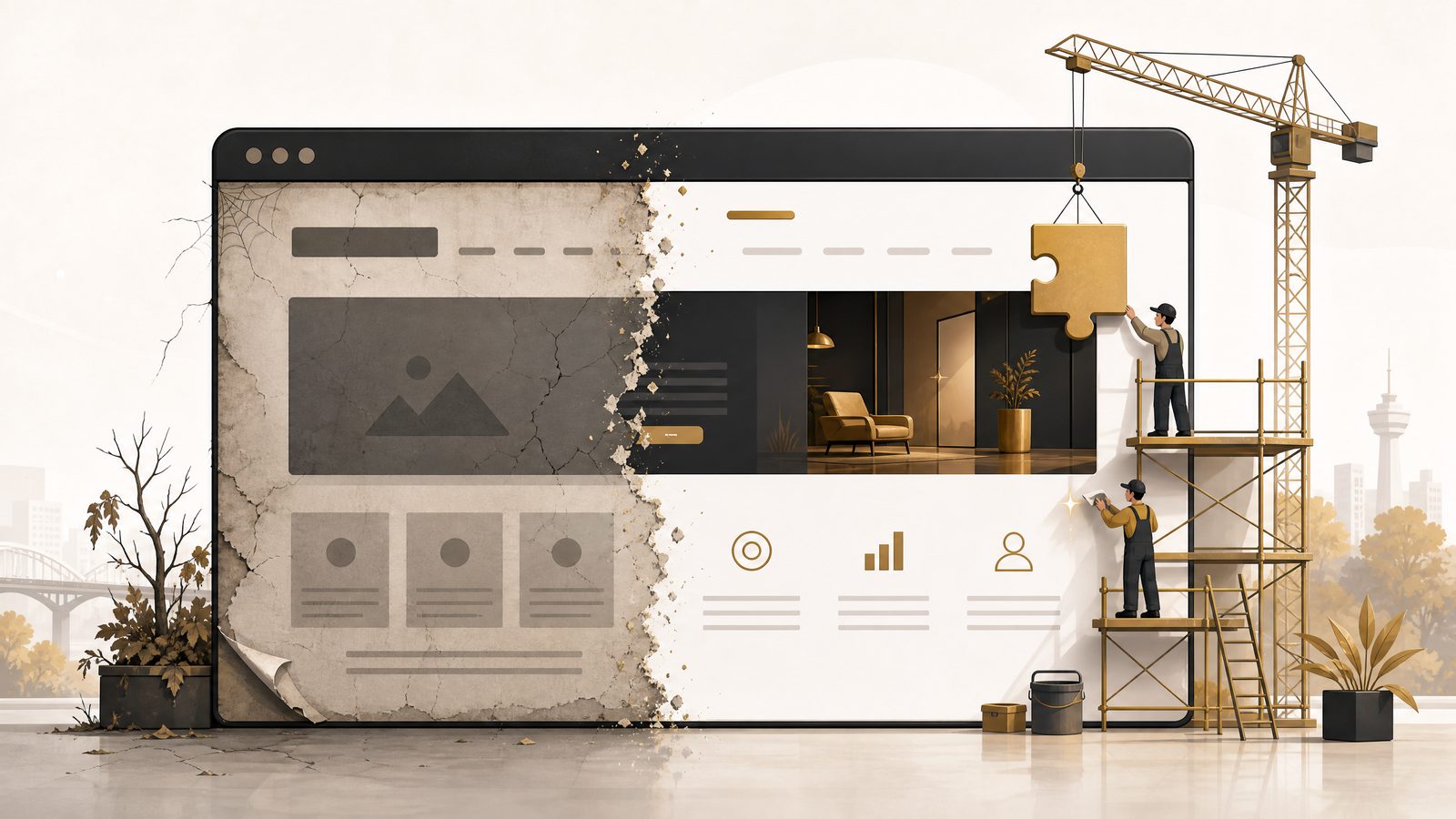
If your business website has been running in the background without much attention, it may be quietly working against you. A website that once looked professional and performed well can fall behind quickly as technology, design standards, and customer expectations evolve. Recognizing when your website needs an upgrade is one of the most important things you can do to protect your online presence and keep new customers coming through the door.
The good news is that the warning signs are usually obvious once you know what to look for. Whether your site was built five years ago or last year, any of these five issues can erode trust, hurt your search rankings, and cost you leads every single day. This post walks you through each one with a straightforward self-check so you can assess where you stand right now.
And if you recognize more than one of these issues in your own site, we will also show you how Park Media’s subscription-based website service gives Saskatchewan and Alberta businesses a smarter, more affordable way to get a professionally built and maintained website without the traditional agency price tag.
[IMAGE-1]Sign 1: Your Website Is Not Mobile-Friendly
The majority of web traffic today comes from smartphones and tablets. If your website was designed primarily for desktop viewing, visitors on mobile devices are likely seeing cramped text, broken layouts, images that don’t scale properly, and buttons that are nearly impossible to tap. Most of them will leave within seconds and find a competitor instead.
Google’s search algorithm also prioritizes mobile-first indexing, which means a site that performs poorly on mobile will rank lower in search results, even for desktop searches. A website that isn’t responsive is not just an aesthetic problem; it is a direct hit to your visibility.
Self-Check: Test Mobile Responsiveness
- Pull up your website on your phone right now. Can you read the text without zooming in?
- Are the navigation menu and buttons easy to tap with your thumb?
- Do images load properly and fit within the screen width?
- Use Google’s free Mobile-Friendly Test tool (search for it in Google) and enter your URL.
If any of these checks reveal problems, your website needs an upgrade before another potential customer bounces away.
Sign 2: Your Website Loads Too Slowly
Page speed is not a technical luxury. It is a baseline expectation. Visitors expect a page to load in two to three seconds, and abandonment rates climb sharply after that threshold. A slow website does not just frustrate visitors. It signals to search engines that your site may not be delivering a quality experience, which can suppress your rankings.
Slow load times are often caused by unoptimized images, outdated hosting infrastructure, bloated code, or too many third-party scripts running on the page. These are exactly the kinds of issues that accumulate over time on websites that aren’t actively maintained.
Self-Check: Measure Your Load Speed
- Use Google PageSpeed Insights (pagespeed.web.dev) to test your site: it gives you a score and a list of specific issues.
- Try loading your homepage on both WiFi and a mobile data connection. Count the seconds.
- Check whether images on your site are enormous file sizes that have not been compressed.
- Ask yourself when your website was last moved to a newer, faster hosting environment.
If your score is below 70 on mobile or your pages take more than three seconds to load, this is a clear sign your website needs an upgrade, not just a tweak.
Sign 3: Your Design and Content Are Outdated
Design trends move quickly, and a website that looked modern five years ago can now communicate the wrong message entirely. Dated typography, heavy use of stock photos that look generic, cluttered layouts, and missing social proof like reviews or case studies can all make a business look less credible than it actually is. First impressions happen within seconds, and your website’s design is making one whether you intend it to or not.
Beyond aesthetics, outdated content is equally damaging. If your website still lists services you no longer offer, references promotions that ended two years ago, or features team members who have since moved on, it creates confusion and erodes trust. A website should reflect your business as it is today, not as it was when the site launched.
Self-Check: Evaluate Your Design and Content
- Look at your website the way a first-time visitor would. Does it immediately communicate what you do and who you serve?
- Is your contact information, pricing, and service list current and accurate?
- Compare your site visually to two or three competitors. Does yours feel dated by comparison?
- When was the last time you published a new blog post, updated a service page, or refreshed your photography?
Sign 4: Your Website Is Not Generating Leads or Inquiries
A website that exists but doesn’t convert visitors into contacts, calls, or customers is not doing its job. If you can’t remember the last time someone told you they found you through your website, that is a significant warning signal. Lead generation doesn’t happen by accident: it requires clear calls to action, strategically placed contact forms, compelling service descriptions, and the kind of trust signals that make visitors feel confident reaching out.
Many older websites were built with a “brochure” mindset: put information online and let people find their own way. Modern websites are built with conversion in mind. Every page should guide a visitor toward a specific next step, whether that is calling your office, submitting a form, or booking an appointment. If yours doesn’t do this, your website needs an upgrade to start earning its keep.
Self-Check: Audit Your Conversion Elements
- Is there a clear, visible call to action on your homepage above the fold?
- Do your service pages have contact forms or phone numbers within easy reach?
- Does your site display any social proof: testimonials, reviews, logos of clients served?
- If you have Google Analytics or any tracking in place, what is your bounce rate and average session duration?
Even a well-designed website can underperform on lead generation if it lacks a solid SEO strategy to bring qualified visitors in the first place. If traffic is the problem, that is a separate layer to address alongside the redesign.
Sign 5: Your Website Is Difficult or Expensive to Update
If making a simple change to your website, such as updating a phone number, swapping a photo, or adding a new service, requires you to call a developer, wait a week, and pay an invoice, something is fundamentally wrong with how your website is set up. A business website should be a living asset that your team can manage without being held hostage by technical complexity or high ongoing costs.
Worse, websites that go unmaintained because updates feel too costly or complicated tend to accumulate security vulnerabilities. Outdated plugins, expired SSL certificates, and unpatched software are all open doors for hackers. A compromised website can disappear from search results entirely and damage your reputation with customers who receive security warnings in their browsers.
Self-Check: Review Your Maintenance Situation
- Do you know when your website’s software, themes, and plugins were last updated?
- Is your SSL certificate current (your URL should start with https://, not http://)?
- Do you have a backup system in place in case something goes wrong?
- What does it cost you in time and money every time you need a change made?
How These 5 Signs Compare: A Quick Reference
Here is a side-by-side look at each warning sign, what it costs you, and what the right solution addresses:
| Warning Sign | Primary Business Impact | What the Fix Requires |
|---|---|---|
| Not mobile-friendly | Lost traffic, lower Google rankings | Responsive redesign |
| Slow loading | High bounce rate, poor search visibility | Optimized build and hosting |
| Outdated design and content | Reduced trust and credibility | Modern redesign, content refresh |
| Not generating leads | Missed revenue, poor ROI | Conversion-focused layout and SEO |
| Hard or expensive to update | Security risk, operational burden | Managed platform with ongoing support |
The Smarter Way to Upgrade: A Professionally Managed Website Subscription
If you recognized two, three, or all five of these signs in your current website, the path forward doesn’t have to mean a large upfront agency project with a five-figure price tag. Park Media’s website subscription service was built specifically to give Canadian businesses a complete, professionally designed, and actively maintained website on flexible month-to-month terms.
Every plan includes a custom-designed website, reliable Canadian Owned and Operated hosting, security monitoring, software updates, and ongoing support. If your business serves customers in Saskatchewan, our team has deep experience building sites for this market, and if you are in Alberta, we offer dedicatedEdmonton web design and Calgary web design services as well.
Plans start at $119 per month with a one-time $199 setup fee. You can review full details on our subscription pricing page to find the right fit for your business.
A website is not a one-time project. It is an ongoing business asset that needs the same attention as any other part of your operation. Park Media’s subscription model keeps it current, secure, and performing, without the overhead of managing it yourself.
Ready to Upgrade Your Business Website?
If your website needs an upgrade, there is no better time to act than now. Every month with a slow, outdated, or poorly converting website is a month of lost opportunities. Get started with Park Media today and let our team build you a professional website that works as hard as you do, fully managed, always current, and backed by a Canadian team that understands your market.